The Polished Marble Myth: What Makes a Hotel Interior Feel Considered
A considered hotel interior depends on scale, texture, light, and repeated details—not costly surfaces alone. Learn what to notice and why it works.
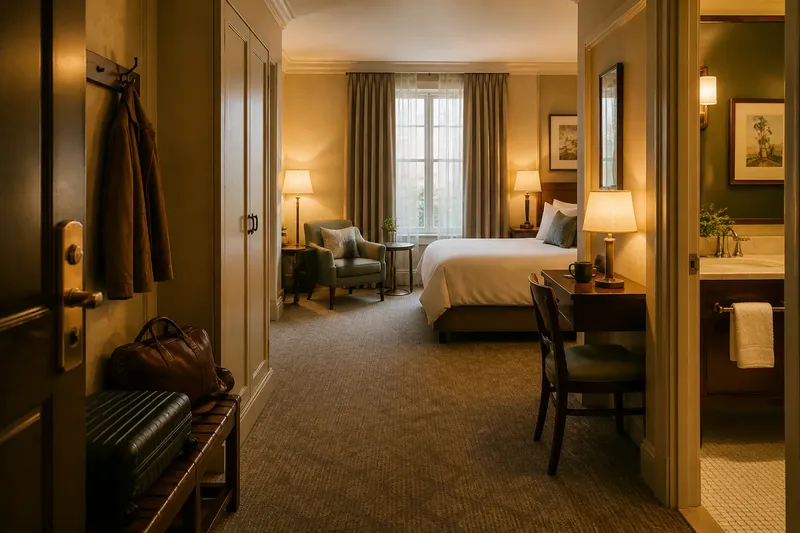
A veined stone counter can look striking in a hotel room yet feel out of place beside a low ceiling, harsh lighting, or a jumble of finishes. A considered hotel interior comes from how scale, texture, light, and repeated details work together, not from one expensive surface.
Use these five cues to read a room beyond its price signals. They also offer practical ways to make design choices feel more coherent without adding another showpiece.
1. Does the scale suit the room?
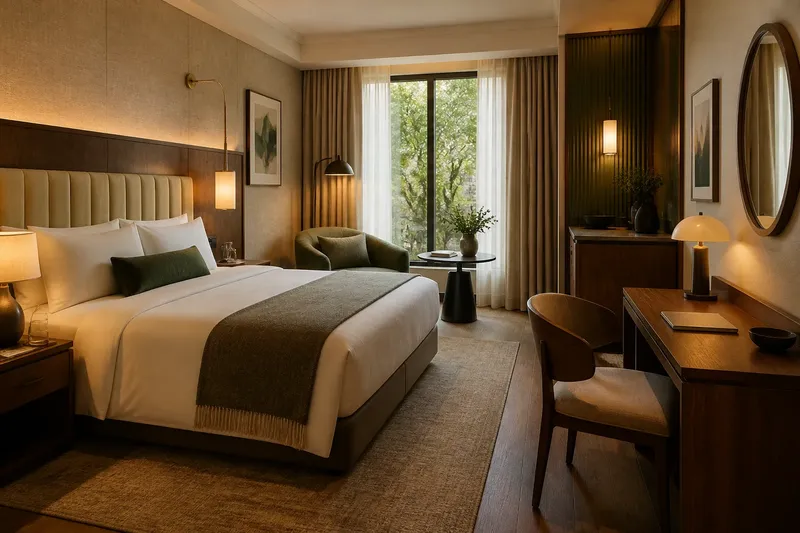
Scale is the relationship between an object and the space around it. A broad upholstered headboard can give a spacious room a clear focal point; in a narrow room, the same visual weight may crowd the wall and compete with bedside lamps.
Look at the outline of the main pieces before judging their finishes. Notice whether the bed, desk, chair, and lighting leave visible breathing room, and whether any one object seems to dominate without a clear reason. A small room can feel deliberate with a few well-proportioned pieces, while a larger room may need substantial forms to keep it from feeling bare.
Consider the view from the doorway as well as from the bed. Furniture that reads as a balanced arrangement from one position may block a window or create a cramped corner from another. The point is not to make every object small; it is to make the objects feel suited to their setting.
2. How do the textures relate?
Materials make a stronger impression through contrast and repetition than through expense alone. Smooth stone beside woven fabric, matte wood beside a softly reflective lamp, or a ribbed panel beside a plain wall can give the eye a sequence to follow.
Texture also changes how a surface feels visually. A room built from glossy tile, lacquer, glass, and polished metal can appear busy when every surface catches the eye in the same way. A quieter finish nearby—such as linen curtains, a wool rug, or matte-painted cabinetry—gives those reflections somewhere to settle.
Check whether each material has a useful role. A hard surface may make sense around a basin, while fabric can soften a seating area; repeating either material in an unrelated place just to match may make the room feel staged. A restrained palette does not mean identical surfaces. It means differences that seem chosen rather than accumulated.
3. What is the light doing?
Light reveals the room’s materials and shapes, so a costly finish cannot carry the design if the lighting flattens it. A single bright ceiling fixture may cast strong shadows, make a textured wall look uneven, and leave a reading chair without comfortable light.
Notice the layers: ambient light for general visibility, task light near a desk or bed, and softer accent light that picks out a surface or corner. These need not be elaborate fixtures. A shaded bedside lamp and a well-placed wall light can make different parts of a room feel legible for different activities.
Color matters, too. Warm light can make timber and fabric feel softer, while cooler light may sharpen pale stone and metal. Rather than deciding from a bulb’s label alone, observe what the light does to the actual finishes and whether the room still feels balanced at night.
4. Which details repeat, and why?
Repetition gives a room a visual rhythm. The same curved line might appear in a mirror, chair back, and lamp base; a muted green might recur in a cushion, artwork, and glazed tile. A few echoes help separate choices feel related without making the room look like a matching set.
Say you are choosing finishes for a small guest room with a walnut desk and cream walls. You could repeat the wood tone in a slim picture frame, then echo a rounded desk edge in the bedside lamp and mirror. The expected result is a room whose pieces feel connected, while the different materials keep the arrangement from looking copied.
Look for repetition at a distance as well as close up. A small detail may be pleasing on its own but disappear across the room; a strong pattern repeated on every surface can become monotonous. The useful question is whether the repeated feature helps the eye move through the space.
5. Does the room have a clear visual hierarchy?
A considered interior gives the eye somewhere to begin and somewhere to rest. In a hotel room, that might be a bed framed by a simple wall treatment, with a desk and artwork remaining secondary. If every object is bold, the room can feel noisy even when each piece is attractive.
Hierarchy does not require a dramatic centerpiece. It can come from contrast: a dark chair against a pale wall, a textured headboard against smooth paint, or a pendant positioned to mark a small seating area. Supporting elements should be visible enough to do their work without challenging the main focus.
What questions help you read a hotel interior?
Can expensive materials make a room feel coherent?
Not by themselves. Marble, brass, or specialty tile can draw attention, but coherence depends on how those materials relate to the room’s proportions, lighting, and other finishes.
How many finishes should a room use?
There is no fixed count that suits every room. Instead, notice whether each finish has a distinct purpose and whether transitions between surfaces feel intentional rather than abrupt.
What makes a hotel room feel calm rather than plain?
Calm often comes from a clear visual hierarchy: one or two focal elements, supportive textures, and lighting that suits the room’s uses. Plainness tends to appear when those cues are absent, not simply because the palette is restrained.
Which detail should you notice first?
Start with the room’s largest forms, then follow the light to the surfaces it reveals. This makes it easier to see whether smaller accents belong to the overall composition or are competing for attention.
What is not worth the effort is adding a decorative finish to every surface just to make a room look expensive. Ask instead whether the materials suit their roles, whether the light reveals them well, and whether a few details recur with purpose. A hotel interior feels considered when its choices make sense together, not when each one tries to impress alone.